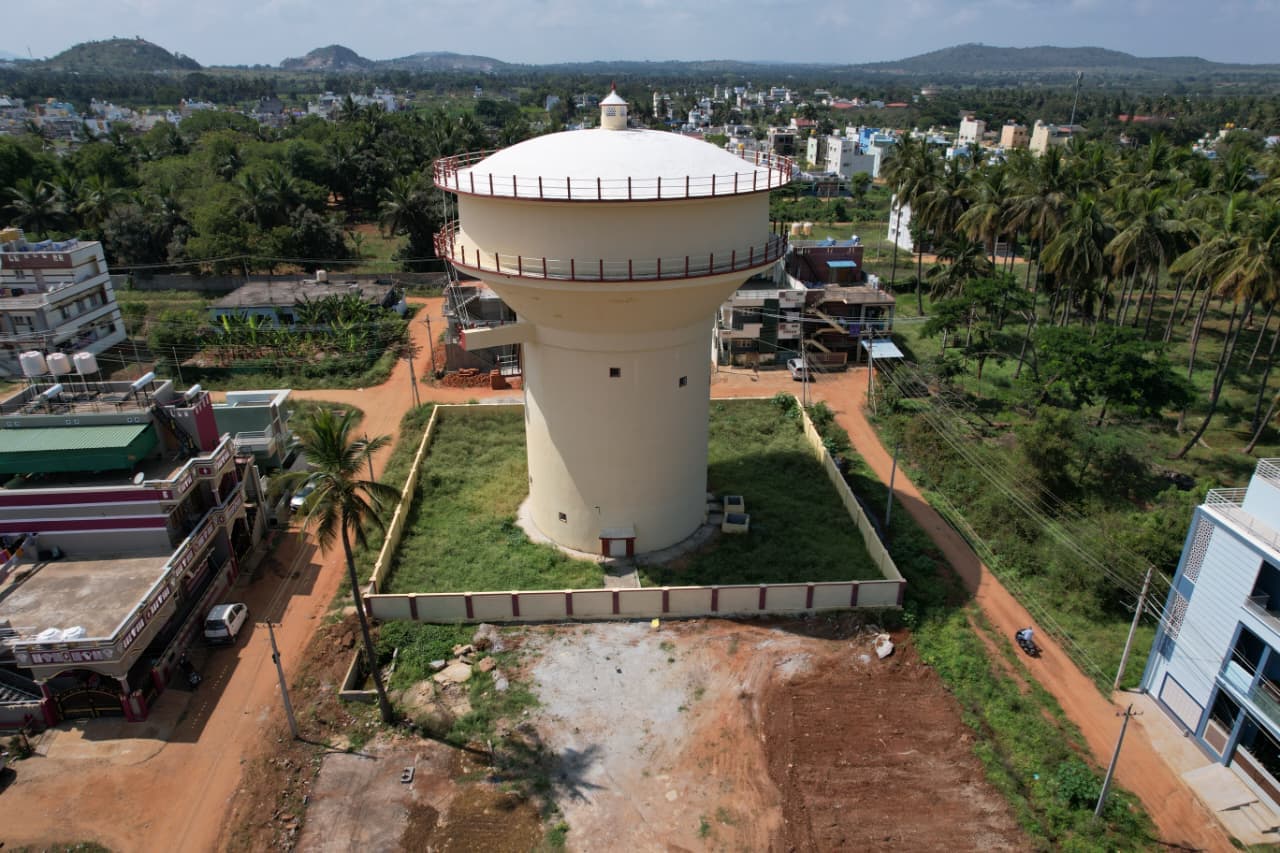
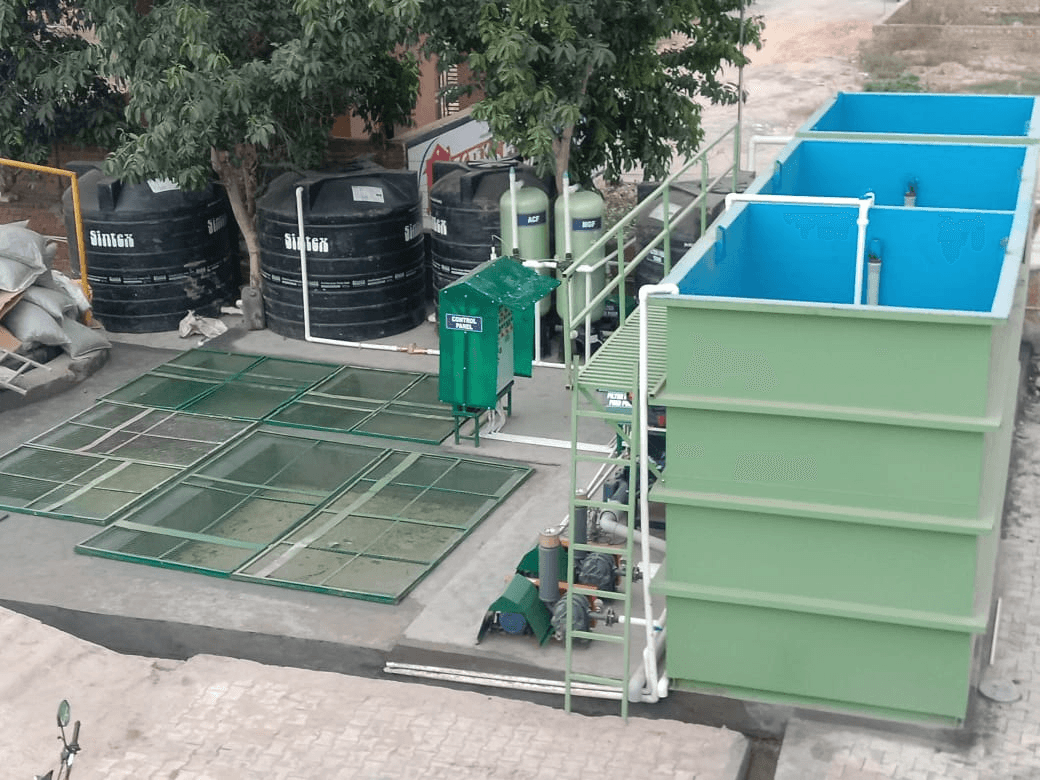
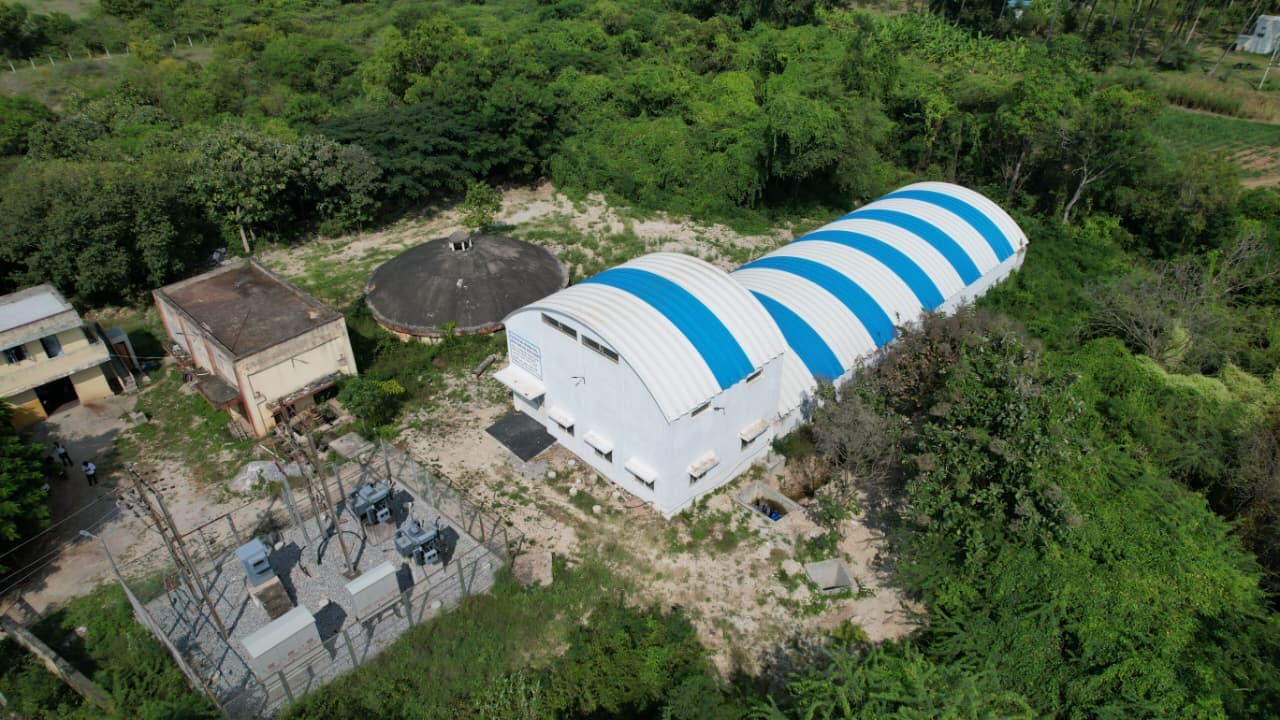
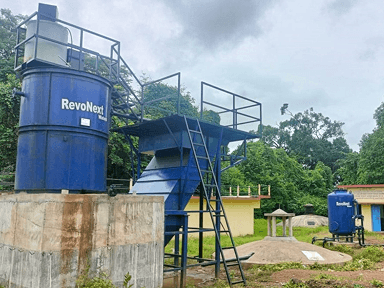
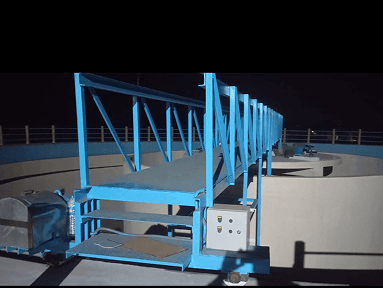
Decanter (for SBR Plants)
Moving decanter mechanism for clean supernatant withdrawal during the decant phase of SBR cycles.

RevoNext Waters designs and installs sewage treatment plants using MBBR (Moving Bed Biofilm Reactor) and SBR (Sequential Batch Reactor) technologies for municipalities, residential developments, hospitals, and commercial complexes across South India.
About STP
A Sewage Treatment Plant (STP) collects domestic wastewater from households, commercial establishments, and institutional buildings and treats it through a series of physical, biological, and chemical processes to produce treated effluent that meets CPCB or KSPCB discharge standards — safe for release to drains, water bodies, or reuse for irrigation and flushing.
In India, STPs are mandated by pollution control boards for townships above a certain population, all new industrial estates, and government housing projects. Municipal bodies require STPs to meet AMRUT and Smart Cities programme targets for 100% sewage treatment. Decentralised STPs serve residential complexes and campuses where connecting to a municipal system is not feasible.
RevoNext Waters specialises in MBBR-based and SBR-based STP designs — the most compact, reliable, and low-maintenance technologies for South Indian conditions. We also execute conventional activated sludge process (ASP) STPs for larger municipal schemes.
Technology Choice
Both technologies achieve excellent BOD and TSS reduction. The right choice depends on your flow patterns, available footprint, and operational preference.
MBBR Technology
Moving Bed Biofilm Reactor uses suspended plastic carrier media to grow a biofilm that breaks down organic matter continuously. It is compact, robust, and handles flow variations well — making it ideal for most residential and commercial STPs.
Smaller Footprint
MBBR tanks are significantly more compact than conventional activated sludge systems
Handles Flow Variation
Continuous operation means it manages peak morning and evening sewage flows without performance drops
Lower Operating Complexity
Fewer mechanical components and a relatively simple process makes daily operation manageable
SBR Technology
Sequential Batch Reactor uses a fill-react-settle-decant cycle in a single tank. It offers higher flexibility in nutrient removal — particularly for nitrogen and phosphorus — and is well suited to larger municipal and industrial sewage treatment requirements.
Single Reactor Tank
Fewer civil structures required — the same tank handles aeration, settling, and decanting in cycles
Excellent Nutrient Removal
SBR cycles can be tuned for nitrogen and phosphorus removal when effluent limits are stringent
Suitable for Municipal Scale
Proven technology for large municipal STPs from 1 MLD upwards
Treatment Process
A conventional WTP moves water through five main treatment stages. RevoNext Waters designs each stage with equipment matched to your raw water quality and output requirements.
Inlet Screening
Bar screen removes rags and solids at inlet
Equalization
Flow balancing tank smooths peak flows
MBBR Aeration
Biofilm on MBBR media degrades BOD and COD
Clarification
Tube settler or lamella clarifier removes sludge
Disinfection
UV or chlorination before treated water reuse or discharge
Our STP Advantage
Government Approved
Approved by KUWSDB and empanelled for Jal Jeevan Mission and AMRUT 2.0. Pre-qualified for Karnataka government sewage schemes with no additional vendor registration required.
MBBR & SBR Specialists
We design compact MBBR and SBR systems suited for space-constrained sites, ideal for townships, campuses, and decentralised schemes.
IoT Monitoring Platform
Every STP we build is connected to our in-house monitoring platform. Real-time BOD, DO, and flow data for operators and clients.
In-House Manufacturing
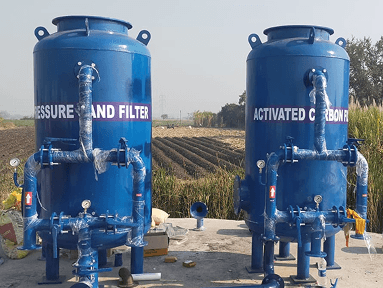
Clarifier bridges, lamella clarifiers, pressure sand filters, manufactured at our state-of-the-art facility in Belagavi, not outsourced.
STP Range We Cover
Equipment
Moving decanter mechanism for clean supernatant withdrawal during the decant phase of SBR cycles.
Grit chamber and detritor mechanisms that separate sand and inorganic grit at the inlet to protect downstream pumps and reactors.
Surface skimming mechanism that removes floating oil, grease, and scum from primary and equalisation tanks.
Surface and diffused aeration systems that supply dissolved oxygen to the biological reactor.
Rotating bridge assemblies for continuous sludge and scum removal in circular clarifiers.
Bottom scraper arms that move settled sludge toward the central hopper for withdrawal.
Gravity thickener mechanism that concentrates sludge before dewatering and reduces downstream load.
Filter press, screw press, or centrifuge dewatering equipment that cuts sludge volume for economical disposal, chosen to suit the plant.
Tank agitators and flash mixers for chemical dispersion and homogenisation.
HDPE K3 and K5 carrier media for moving bed biofilm reactors, available for standalone supply to contractors.
Manual and mechanically raked bar screens for STP inlet channel screening. Coarse and fine screen options.
Ultraviolet disinfection chambers for STP treated water. Chemical-free pathogen kill before reuse or discharge.
Common questions about MBBR and SBR sewage treatment plant design and compliance.
MBBR (Moving Bed Biofilm Reactor) uses suspended plastic carrier media to grow a continuous biofilm that breaks down organic matter. It is compact, handles flow variation well, and is suitable for most residential and commercial STPs. SBR (Sequential Batch Reactor) uses a single tank operating in timed cycles: fill, react, settle, decant. SBR offers greater flexibility in nutrient removal (nitrogen and phosphorus) and is better suited to larger municipal schemes above 1 MLD.
Share your project requirements — capacity, sewage source, location, and intended reuse. Our engineering team will review and respond within 24 hours.